
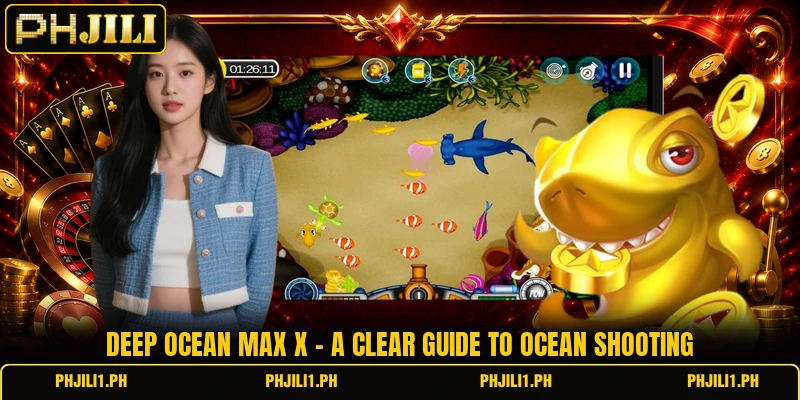
Deep Ocean Max X places members inside a moving underwater field where fish, bonus creatures, and changing effects create continuous shooting decisions. This article is written for Filipino players using PHJILI, helping them understand the format, controls, rules, and match-focused methods before joining a room.
Introducing Deep Ocean Max X and its fundamental format
The game uses an ocean screen filled with targets that cross from several directions at different speeds and distances. Each shot consumes the displayed stake, while a successful capture returns a value linked to that creature and room setting. Players must watch movement, distance, crowding, and remaining screen time before choosing where to fire.
PHJILI presents the title through a digital lobby where available rooms may show different entry conditions and shot values. Deep Ocean Max X keeps the main action centered on aiming, firing, switching power, and reacting to special targets during busy sequences. Account settings may display values in PHP or USD, so members should confirm the active currency and selected shot level before a round.

Core rules and mechanics for accurate underwater play
Every round follows a simple cycle: enter a room, select shot strength, aim at moving creatures, and fire through the available cannon controls. Results depend on the game system, so repeated hits never guarantee that a target will be captured on the next attempt.
Starting Deep Ocean Max X rounds
Players begin by opening the game page and choosing an available room with suitable displayed conditions and a comfortable shot range. The screen normally shows the cannon, current stake, balance, targets, active effects, and any temporary event indicators. Before firing, members should identify how the aim point follows mouse movement or touch input across the full ocean field.
A single press sends one shot toward the selected position, while holding the control may enable repeated firing where the interface supports it. Shot power can often be changed through nearby plus and minus controls positioned beside the cannon. Members should confirm each adjustment because a higher level uses more PHP or USD for every separate attempt.
Choosing objectives and shot levels
Small creatures usually move quickly and appear in groups, creating several aiming opportunities within a short and crowded screen period. Larger targets remain visible longer but may require more attempts before capture under the active game calculation. Players should select based on screen position, travel direction, and available firing time rather than size alone.
In Deep Ocean Max X, a target near the center gives more time for follow-up shots than one already leaving the edge. A PHP 20 or USD 1 shot can be treated as an example, not a fixed platform limit or promised conversion. The actual amount shown on screen should guide every cannon change before members continue firing.
Understanding incentives and special events
Captured targets add the displayed result to the game balance after the system confirms the successful hit and completes any related effect. Values may differ across creatures, room settings, temporary events, and special sequences shown during a session. Members should read every visible label instead of assuming that similar-looking fish carry identical returns or functions.
View more: Kraken Arena Neo – Rules, Features, And Clear Play Guide
Special creatures can trigger wider attacks, chain effects, multipliers, or short bonus sequences depending on the active version and room presentation. Deep Ocean Max X may also place several targets together during crowded moments that last only a few seconds. Players should wait for clear alignment before spending multiple shots on a brief effect with limited coverage.

Focused methods for stronger objective selection and timing
Deep Ocean Max X rewards careful observation because targets follow visible paths, overlap briefly, and leave the screen through predictable outer edges. Strong decisions come from reading these patterns and matching shot direction to the available firing window instead of tapping without a chosen target.
Reading movement before firing
A moving target should be approached by aiming slightly ahead of its current position rather than directly at the center of its body. Faster creatures need more forward space, while slower ones allow tighter correction and easier follow-up aiming. This approach reduces shots that arrive after the selected target has already passed the impact point.
Players can study two or three target paths before committing to repeated fire across one narrow section of the screen. In Deep Ocean Max X, crossing lines sometimes place several creatures inside one shared firing area for a brief moment. That situation can support better shot coverage without relying on random screen tapping or constant direction changes.
Using weapon switches with purpose
Shot strength should change because the target or screen situation changes, not simply because several previous attempts failed. Lower settings suit quick testing against passing groups, while stronger settings can support a selected special creature that remains visible longer. Members should return to the prior level when that opportunity disappears or moves outside a clear firing line.
Some rounds may offer temporary weapons, locks, nets, or area effects through visible icons placed near the normal cannon controls. Deep Ocean Max X requires players to read each effect before activation because duration, direction, and coverage can differ. A well-timed tool works best when several valuable targets remain inside its reach for the full active period.
Selecting chambers by match conditions
Room choice affects the displayed shot range, target values, and overall pace presented on the screen during each available match. New members can compare available labels before entering rather than selecting the first open option without checking its conditions. A room showing PHP values should not be confused with another account view using USD amounts.
Players should also check connection stability and control response immediately after the selected room finishes loading. Deep Ocean Max X depends on accurate input, so delayed movement can make careful aiming difficult during faster target crossings. Changing rooms can help when the current pace or stake display does not match the intended type of session.

View more Category: Fish
Conclusion
Deep Ocean Max X offers structured ocean shooting through moving targets, adjustable weapons, special effects, and room-based stake displays. Members can review the controls, room labels, and currency details on PHJILI before committing shots during active rounds. Download the app, register an account, open the game, and good luck with every underwater match.